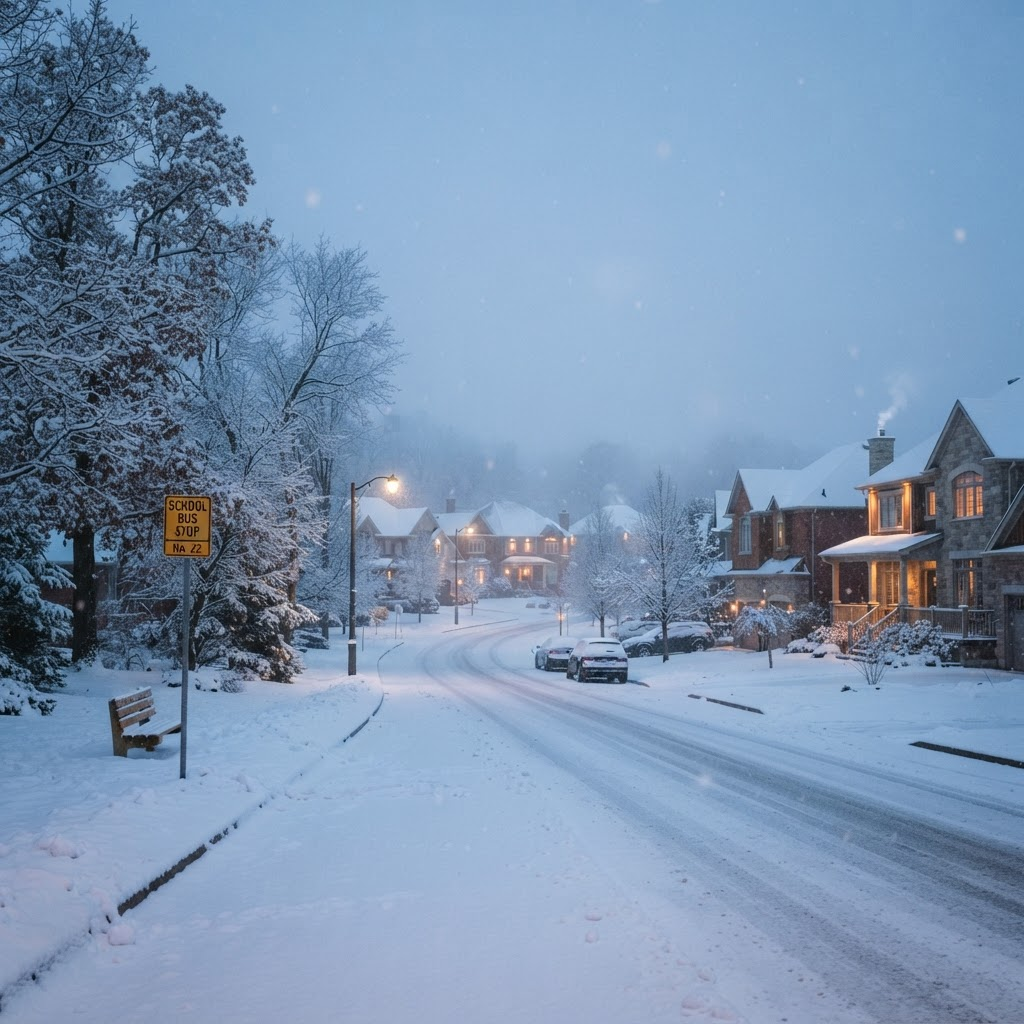
What actually triggers a snow day?
It's tempting to think a snow day is simply a matter of “enough snow.” In reality, superintendents make the call based on a bundle of overlapping variables, often before sunrise and with incomplete information. A good snow day predictor mirrors that decision-making process: it doesn't just count inches, it weighs several factors the way a human decision-maker would.
The best tools combine live forecast data with the specifics you provide — your ZIP code, your school type, and how snow-prone your area is — to produce a single percentage. That number is an estimate of risk, not a promise, and understanding the inputs helps you read it correctly.
Snowfall accumulation
The headline number. A dusting of an inch rarely closes schools, while 6+ inches overnight almost guarantees a closure in most regions.
Temperature
Extreme cold can close schools even without snow. Sub-zero wind chills make waiting at bus stops genuinely dangerous.
Wind & drifting
High winds cause blowing and drifting snow that reduces visibility and re-covers roads minutes after plows pass.
Timing of the storm
A storm that peaks during the pre-dawn commute is far more disruptive than one that clears by midnight.
Local geography
Rural districts with long bus routes and untreated back roads close more readily than compact urban districts.
District policy
Some districts have used all their snow days already, or lean on remote learning — both change the calculus.
The math behind the percentage
Under the hood, a snow day predictor assigns weights to each factor and blends them. Predicted snowfall might carry the most weight, but temperature and timing can override it — a light snowfall on top of ice during the morning commute can be more dangerous than a heavy, well-timed storm that plows can clear.
The model then normalizes everything into a probability from 0% to 100%. A result of 70% doesn't mean “70% of the day off” — it means that under similar conditions historically, schools closed roughly 7 times out of 10. That framing is what makes a well-built calculator trustworthy: it communicates uncertainty honestly instead of pretending to be a crystal ball.
“A snow day prediction is really a risk score. The goal isn't certainty — it's a well-calibrated estimate you can plan your morning around.”
How to check your own odds
You don't need to model any of this by hand. The Snow Day Predictor takes your location and school details and returns an instant probability using current forecast data. It's the fastest way to answer the only question that really matters the night before a storm.
Will school be closed tomorrow?
Get an instant, location-based snow day probability in seconds. Just enter your ZIP code and school type.